
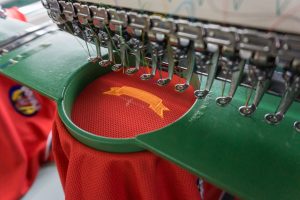
Custom embroidery takes an ordinary item and turns it into something unique. It adds a touch of flair to anything from business apparel to sports merchandise, making an otherwise plain product stand out and showing off your brand. At Tri-Valley Sports, custom embroidery is one of our specialties, and we’re always happy to share our knowledge and expertise.
Check out these five fun facts about custom embroidery that you probably didn’t know!
We can embroider more than just shirts.
Often, when one thinks about embroidery, sports uniforms or work polos are two of the top products that come to mind. However, thanks to ongoing technological advances, the embroidery process has become much more diverse. Hats, duffel bags, and umbrellas are not ideal for customization. Of course, these are just a few items; the possibilities are endless when it comes to marketing your company or team.
The needle selection affects the final result.
Often underestimated, the needle is one of the most important elements of the custom embroidery process. Contrary to popular belief, needles are not a one-size-fits-all solution. To select the appropriate needle for the job, one must consider the fabric type. Sharp and blunt needles serve different purposes depending on the material. Needle size will also vary by project.
Ancient embroidery was a sign of status.
Items such as robes, handkerchiefs, pouches, and flags often featured custom hand-stitched embroidery. Because of the time and exclusivity these items demanded, only the wealthiest and highest-ranking were adorned with such luxuries in ancient times.
The first needles were made from bone.
Before we developed the ability to craft metal into thin, sturdy shapes, early embroidery was done with bone needles. When carefully carved, these animal-bone needles were effective for intricate, detailed work.
The first embroidery machines were invented in the early 1800s.
French inventor Joshua Heilmann invented a hand-operated device that moved fabric into a double-ended needle in 1829. This invention paved the way for innovation in the textile industry. In 1863, Swiss inventor Isaak Groebli’s Schiffli embroidery used a continuous thread and shuttle, enabling mass production and leading to modern automated machines.